inquiry
Leave A Message
If you are interested in our products and want to know more details,please leave a message here,we will reply you as soon as we can.
submit
Bengbu Longkai Welding Protection Technology Co.,Ltd.
Home

powered purified air respirator

powered purified air respirator

  • PAPR Cartridge Replacement: Cycle & Key Considerations
    PAPR Cartridge Replacement: Cycle & Key Considerations
    Dec 09, 2025
      In scenarios with toxic and harmful gases such as chemical workshops, painting stations, and laboratories, PAPR (air purification respirator) is undoubtedly a "breathing barrier" for practitioners. As the core component of PAPR that filters toxic media, the timing of cartridge replacement directly affects the protective effect—replacing too early causes cost waste, while replacing too late may expose users to risks. Many users are accustomed to replacing "based on experience or fixed timetables," but overlook the impact of environmental differences and operational details. Today, we will sort out the scientific replacement cycle of PAPR cartridges and the key precautions to avoid safety hazards.   First of all, it is clear that there is no unified "fixed replacement cycle" for cartridges. Their service life is affected by four core factors and must be judged dynamically based on actual scenarios. The most critical factor is the concentration and type of pollutants. For example, in a high-concentration organic vapor environment, the adsorption capacity of the cartridge will be saturated quickly, and replacement may be required within a few hours; while in a low-concentration, intermittent exposure scenario, the service life can be extended to several weeks. Secondly, the duration of use matters—continuous 8-hour work per day requires a different replacement frequency than occasional short-term use. Environmental temperature and humidity cannot be ignored either; high temperature and humidity will accelerate the aging of the adsorbent in the cartridge and reduce adsorption efficiency. For instance, in a hot and humid spraying workshop in summer, the replacement interval should be appropriately shortened. Finally, the model and specification of the cartridge also have an impact. Cartridges from different brands designed for different gases (such as acidic gases, organic vapors, ammonia, etc.) have different adsorption capacities and design lifespans, so judgment should be based on the manufacturer's instructions.   Although there is no fixed cycle, there are four intuitive signals that "mandate replacement", which users must always be alert to. The first is "odor perception"—when a pungent odor of pollutants is smelled while wearing the PAPR, it indicates that the cartridge has failed and the adsorbent can no longer block toxic gases, so immediate shutdown and replacement are necessary. The second is "change in breathing resistance"—if the PAPR's air supply feels heavy and more effort is needed for breathing, the adsorbent inside the cartridge may be saturated and caked, causing blockage of the air flow channel. In this case, replacement is required even if the expected cycle has not been reached. The third is "alarm prompt"—some intelligent powered air respirator are equipped with cartridge life monitoring devices, which will issue an audio-visual alarm when the preset saturation threshold is reached, which is the most direct replacement instruction. The fourth is "shelf life and storage period"—even if unused, cartridges exposed to air after opening will gradually absorb moisture and impurities, and generally should not be stored for more than 30 days after opening; unopened cartridges must also be used within their shelf life, as their adsorption performance will drop significantly after expiration and they can no longer be put into use.   In addition to grasping the replacement timing, operational standards during replacement are equally important, as they directly determine whether the new cartridge can exert its due effect. Preparation is required before replacement: first, shut down and power off the PAPR to avoid accidental contact with the air supply device during replacement; then move to a clean, pollutant-free area to operate, preventing toxic gases from entering the mask or contaminating the new cartridge during replacement. Attention should be paid to sealing during replacement: after removing the old cartridge, check whether the sealing gasket at the connection interface is damaged or aged—if the gasket is deformed, it needs to be replaced in time; when installing the new cartridge, align it with the interface and tighten it clockwise until a "click" sound is heard to ensure there are no loose gaps. An airtightness test must be carried out after replacement: put on the PAPR, turn on the air supply, and cover the air inlet of the cartridge with a hand. If negative pressure is generated in the mask and the mask fits tightly against the face during breathing, it indicates good sealing; if there is air leakage, recheck the installation or replace the sealing components.   Finally, there are some easily overlooked details that can further extend the service life of the cartridge and improve protection safety. First, keep usage records—record the cartridge model, replacement date, usage scenario, and pollutant concentration each time it is replaced. By accumulating data, gradually explore the replacement rule suitable for your own work scenario. Second, store cartridges in categories—different types of cartridges (such as those for organic vapors and acidic gases) should be stored separately to avoid confusion in use. Using the wrong cartridge not only fails to provide protection but may also damage the equipment due to chemical reactions. Third, dispose of waste cartridges—failed cartridges may retain toxic media and should be sealed, placed in a special hazardous waste recycling bin, and handed over to professional institutions for disposal. They must not be discarded or disassembled at will. Breathing safety is no trivial matter, and cartridge replacement is never a "formality." Only by scientifically judging the cycle and standardizing the operation process can papr respirators truly become a "solid line of defense" for protecting breathing.If you want know more, please click www.newairsafety.com.
    Read More

  • CE Testing Requirements for Powered Air Purifying Respirators (PAPRs)
    CE Testing Requirements for Powered Air Purifying Respirators (PAPRs)
    Jul 30, 2025
    When it comes to personal protective equipment (PPE) designed to safeguard workers from harmful airborne contaminants, Powered Air Purifying Respirators (PAPRs) stand out as critical tools in industries ranging from manufacturing to healthcare. But to enter the European market, these life-saving devices must meet stringent CE certification requirements. Let’s break down the key testing standards and obligations that manufacturers need to know. ​ Understanding the Regulatory Framework​   First, it’s essential to recognize where PAPRs fit within EU regulations. As devices designed to protect users from respiratory hazards—including dust, fumes, and toxic gases—PAPRs are classified as Category III PPE under Regulation (EU) 2016/425. This classification applies to high-risk equipment where failure could result in serious injury or death, meaning compliance is non-negotiable. ​ Category III PPE requires rigorous testing and oversight by a Notified Body—an EU-accredited organization authorized to verify compliance. Self-declaration is not sufficient here; third-party validation is mandatory.​   Core Standards: EN 12941 and Beyond​   The backbone of CE testing for PAPRs is EN 12941:2001+A1:2009, the European standard specifically governing powered air-purifying respirators. This standard outlines performance, safety, and design criteria, while additional standards address specific components like filters and batteries. Let’s dive into the key testing areas: ​ 1. Airflow Performance: Ensuring Reliable Protection ​ At the heart of a PAPR’s functionality is its ability to deliver a consistent supply of filtered air. Testing here focuses on:​ Minimum airflow rates: For half-masks, the minimum is 160 L/min; for full facemasks, it’s 170 L/min. These rates must remain stable within a 10% tolerance during 30 minutes of continuous operation.​ Positive pressure maintenance: The respirator must maintain a positive pressure (≥20 Pa) inside the mask to prevent unfiltered air from leaking in—even if there’s a small gap (10% leakage) between the mask and the user’s face.​ Flow stability under varying conditions: Tests simulate different breathing rates (from 15 breaths/min at rest to 40 breaths/min during heavy work) to ensure airflow doesn’t drop dangerously.​   2. Protective Efficacy: Blocking Harmful Substances ​ A PAPR’s primary job is to filter out contaminants, so testing verifies both the device’s seal and the performance of its filters:​ Total leakage testing: Using aerosols (like sodium chloride or DOP), testers measure how much unfiltered air enters the mask. For the highest protection levels, total leakage must be ≤0.05%.​ Filter compatibility: Filters must meet standards like EN 149 (for particulate filters) or EN 14387 (for gas/vapor filters). For example, a P100 filter must capture ≥99.97% of 0.3μm particles.​ Seal integrity: The connection between the filter and PAPR host is tested for pressure decay—allowing no more than 50 Pa loss per minute to ensure no bypass.​   3. Mechanical and Structural Safety ​ PAPRs must withstand harsh working conditions without compromising user safety:​ Material durability: Components like masks and hoses undergo extreme temperature cycles (-30°C to +70°C) and UV exposure (72 hours) to check for cracking or deformation.​ Strength testing: Straps, mask attachments, and filter connections must resist forces like 150N (for head straps) and 50N (for filter interfaces) without breaking.​ Impact resistance: Full facemask lenses are tested with a 120g steel ball dropped from 1.3 meters to ensure they don’t shatter.​ 4. Electrical Safety: Powering Protection Safely ​ Since PAPRs rely on motors and batteries, electrical safety is paramount:​ Insulation and grounding: Motors must withstand 2500V AC for 1 minute without breakdown, and metal components must have a ground resistance ≤0.1Ω.​ Battery performance: Batteries (often lithium-ion) must pass EN 62133 tests, including short-circuit, overcharge, and crush scenarios, with no fire or explosion risk. They must also provide at least 4 hours of runtime at rated flow.​ EMC compliance: To avoid interference from tools or radios, PAPRs must meet EN 61000 standards for electromagnetic compatibility.​ 5. Durability and Environmental Adaptability ​ PAPRs are built for long-term use, so testing ensures they stand the test of time:​ Aging tests: Motors run continuously for 500 hours with ≤10% airflow loss, while batteries retain ≥80% capacity after 300 charge cycles.​ Extreme environment performance: Devices must operate in -30°C cold and 40°C/90% humidity without airflow drops or electrical failures.​ Special Cases: Tailoring to Unique Environments​ Certain industries demand extra testing:​ Medical settings: PAPRs used in healthcare must meet EN 14683 for biocompatibility (e.g., no skin irritation) and may require antimicrobial coatings.​ Explosive environments: For use in zones with flammable gases, PAPRs need ATEX certification (EN 13463) to prevent sparks or static discharge.​​   CE testing for best powered air purifying respirator is rigorous, but it’s rooted in a simple goal: ensuring these devices protect users when they need it most. By adhering to EN 12941 and related standards, manufacturers not only gain access to the  EU market but also demonstrate a commitment to safety that builds trust with workers and employers alike.
    Read More
  • BXH-3001 PAPR(powered air purifying respirators) from NEW AIR get CE Certification, TH3 PR SL according to EN12941
    BXH-3001 PAPR(powered air purifying respirators) from NEW AIR  get CE Certification, TH3 PR SL according to EN12941
    Jul 19, 2025
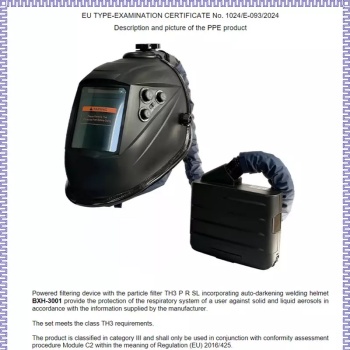
    Understanding the Standards Behind the NEW AIR BXH-3001 EU Type-Examination Certificate When it comes to personal protective equipment (PPE), especially respiratory devices, compliance with rigorous standards is non-negotiable. NEW AIR BXH-3001powered air purifying respirators device with an auto-darkening welding helmet offers a clear example of how these standards ensure safety and reliability. Let’s break down the key standards and regulations that underpin this certification.     The Regulatory Backbone: EU 2016/425 At the core of this certificate is Regulation (EU) 2016/425, a pivotal piece of legislation governing PPE in the European Union. This regulation replaces the older Council Directive 89/686/EEC and sets out essential health and safety requirements (EHSRs) for all PPE sold within the EU. Harmonized Standards: EN 12941 Series Beyond the overarching regulation, the BXH-3001 adheres to the EN 12941 standard, specifically its amendments: EN 12941:1998 EN 12941:1998/A1:2003 EN 12941:1998/A2:2008 These standards are harmonized under EU 2016/425, meaning they are recognized as meeting the regulation’s EHSRs. EN 12941 focuses on purified air powered respirator that incorporate a helmet or hood—exactly the category the BXH-3001 falls into. Key requirements of EN 12941 include: Performance testing: Ensuring the device effectively filters contaminants (in this case, solid and liquid aerosols) and maintains airflow under various conditions. Safety features: Including durability of materials, compatibility with the helmet/hood, and reliability of the powered system (fans, filters, etc.). Marking and instructions: Clear labeling to guide users on proper use, maintenance, and limitations.   Classification: Category III and TH3 Protection The BXH-3001 is classified as Category III PPE, the highest risk category under EU 2016/425. Category III includes PPE designed to protect against “serious risks,” such as exposure to harmful aerosols in welding or industrial environments. This classification mandates strict conformity assessment, including type-examination (Module B) and ongoing production checks (Module C2, as specified in the certificate). Additionally, the device meets TH3 class requirements. Under EN 12941, “TH” refers to the level of protection against aerosols, with TH3 representing a high level of filtration efficiency. This confirms that the BXH-3001, paired with its TH3 P R SL particle filter, reliably shields users from solid and liquid aerosols—critical for welding and similar high-risk tasks.   What This Means for Users and Businesses For workers, this certification is a guarantee that the BXH-3001 papr system has been independently verified to perform as claimed, even in demanding environments. For businesses, compliance with these standards ensures market access within the EU and builds trust in product safety. Notably, the CE mark on the BXH-3001 (accompanied by the notified body number 1024, as required for Category III PPE) is more than a label—it’s a testament to adherence to a robust framework of standards and regulations. In summary, the EU Type-Examination Certificate for the NEW AIR  BXH-3001 is rooted in a foundation of strict standards: EU 2016/425 for regulatory compliance, EN 12941 for technical performance, and clear classification to define its protective scope. For anyone relying on respiratory protection in high-risk settings, understanding these standards is key to choosing the right equipment.  
    Read More

leave a message

leave a message
If you are interested in our products and want to know more details,please leave a message here,we will reply you as soon as we can.
submit
Contact Us: sales@txhyfh.com

home

products

WhatsApp

Contact us